Business wallets, payments and subscriptions in one workspace.
Users
Businesses and their customers
Our work
Product and full-stack engineering
Scope
Mobile · Web · Backend
Status
Product engineering
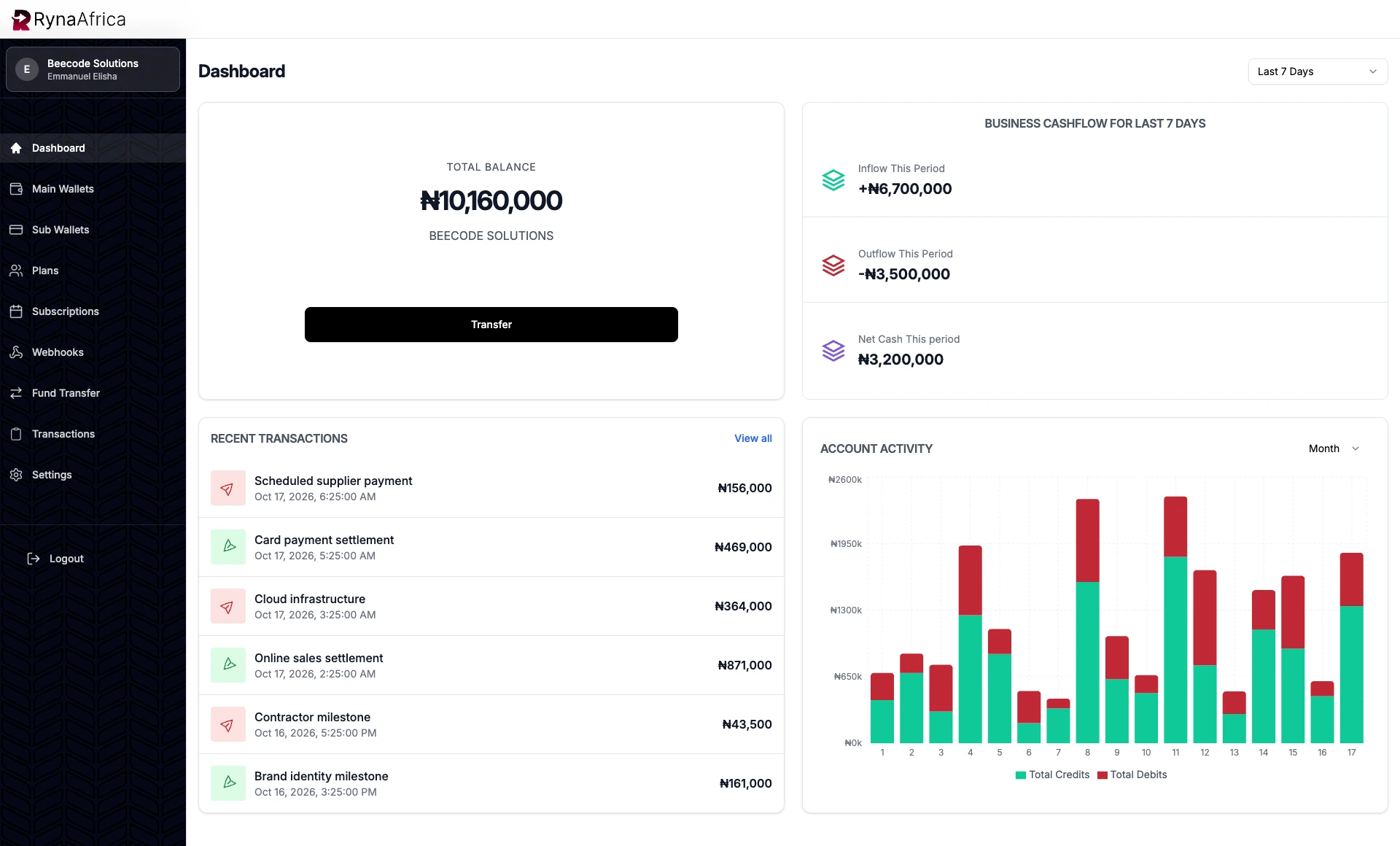
Original product interface shown with demo balances and transactions.
The project
Businesses need to know where their money is, who they are paying and which customers have active subscriptions. We built Ryna’s web, mobile and backend experiences around those needs. Its business workspace brings wallet management, transfers, transaction history and subscription plans together, with tools to investigate a payment or follow up when another system does not respond.
What we built
Organise money by customer or purpose
A business can create named wallets and set their contact details, notifications and fee preferences. We tied each wallet to its owning business and checked related fee-wallet selections against that ownership. Operators can organise activity around a customer or purpose, then inspect the transactions belonging to the wallet they are managing.
Check the recipient and follow the transfer
Before confirming a transfer, users can review the destination account name and an amount checked against the displayed balance. We built transaction views with incoming and outgoing filters, date selection and reference search. These connect the decision to pay with the information an operator needs to find and investigate the payment later.
Manage plans, renewals and access dates
Businesses can define plans with different billing cycles, features and pricing variants. We built prepaid activation and renewal workflows that record the period a customer has paid for. Renewing a plan extends its coverage, while reminders and expiry handling help operators manage what happens as that period ends.
See whether connected systems received an update
Ryna sends business events to other systems through webhooks: automated messages about an activity in the product. We built a delivery history showing pending, delivered, retrying and failed attempts, with a resend action. When a receiving system is unavailable, operators have a record to inspect and a way to try again.
The workflow
What happens after someone confirms a transfer
Submitting a payment is only the beginning. We designed the transfer flow to keep the instruction, account records and provider response connected, including when the response is delayed or unclear.
Check the instruction
The request carries the signed-in business, selected wallet, confirmed recipient and a payment reference. The backend checks wallet ownership and available funds before recording the transfer, keeping the account checks behind the interface.
Update the relevant accounts
For an internal transfer, the sender’s debit, recipient’s credit and both balances update together. An external transfer keeps the reference sent to the payment provider so its eventual response can be matched to the original request.
Find out what actually happened
An unclear response leaves a payment to be checked using its reference. The reconciliation logic compares the amount, source and destination before classifying the result as completed, failed or still pending, giving follow-up work a concrete basis.
The engineering
Keep account rules behind every action
We built dashboard actions that establish the current business before calling wallet and subscription services. Those services check the relevant accounts and update their records. The same business identity therefore follows an action from the screen into the backend, where ownership decisions are made.
Store the period a customer has paid for
A subscription needs more detail than an active label. We modelled coverage dates, distinguished a renewal from a plan change and built background jobs for approaching expiry and expired access. That gives operators dates they can explain to a customer and use when deciding the next action.
Separate an event from its delivery attempts
We kept payment and subscription records separate from webhook attempts. Failed deliveries can be retried a limited number of times, with increasing delays, while the original business event remains available. This makes it possible to investigate an integration problem without confusing it with the underlying payment or subscription.